
On Free Speech and Consequences
Our interpretation of the first amendment has taken a seriously wrong turn in recent years. Americans buy into the concept that freedom of speech means freedom from consequences.

For an amendment that is almost as old as the nation itself, the FIRST Amendment amasses boatloads of misinterpretation and misunderstanding.
Congress shall make no law respecting an establishment of religion, or prohibiting the free exercise thereof; or abridging the freedom of speech, or of the press; or the right of the people peaceably to assemble, and to petition the government for a redress of grievances.
Seems pretty straightforward, not a lot of ambiguity or doubt, right? That is, until a bunch of humans get hold of it to put their own “spin” on the first, most fundamental right of American citizens. Much like various readings of the Bible, words can appear simple or straightforward until humans start deciding what they actually say. We can twist a piece of steel pipe into a pretzel if it suits our purposes to make our personally preferred argument.
We do this with stunning regularity to the First Amendment. While I could point to dozens of occasions where this happens (particularly in our current “religious freedom” debates), let’s focus on the most recent circumstances. You probably heard the story or some version/spin about it on social media.
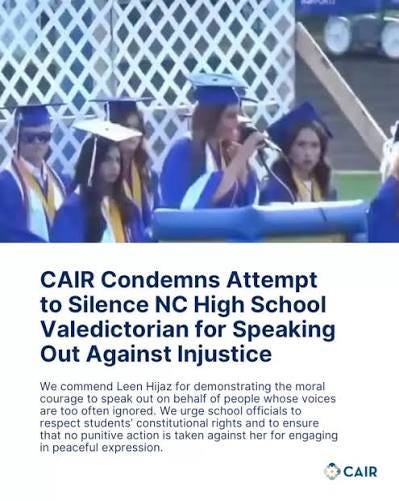
The valedictorian of Clayton High School in Johnson County, North Carolina, was pulled from the microphone for making unauthorized remarks about using our voices to call out suffering of refugees, immigrants, ICE detainees, etc. The principal cut her off at the end after realizing that graduate Leen Hijaz was going off-script with her comments.
Speaking of comments, I read some of those below various Facebook postings about the incident– almost always a mistake. But this time, the posts left some prime discussion topics about the nature of free speech.
Plenty of people left hateful comments towards her and her remarks. Liberal, communist, anti-semite, violent Muslim, America hater. You know the drill. But others zealously defended her, accusing the school of violating her right to free speech. Let’s think about that for a minute, particularly in the context of a graduation speech.
I support Leen Hijaz’s decision to speak to her convictions, and I completely agree with her assertion that students should use their voice to speak out against the ongoing violence and injustice that they see across the globe. I have no issue with the expression of her ideas. And I also have no issue with the principal stopping her.
No school that I know of allows a student to get up at an officially sponsored school event and make a speech without someone looking at it first. Even in middle school, we had to have our student government campaign speeches reviewed by someone (I always lost, btw). Any student that went off-script at any graduation could expect a stoppage and possibly the additional (albeit unnecessary) consequences of her actions.
Our interpretation of the first amendment has taken a seriously wrong turn in recent years. Americans buy into the concept that freedom of speech means freedom from consequences. There is a belief on both sides of the socio-political-religious standoff that one should have permission to say/do whatever they please without any adverse impact. Not only is this unrealistic, it is not assured in the Constitution (in my very amateur-ish interpretation of said document).
The first amendment assures that the government will not impede on one’s speech or religious beliefs. It does not assure everyone that other entities cannot react to such speech. While a school is a government entity, their guidelines for a student speech are (most likely) clearly defined. If the student chooses to go rogue, that is their right. But they are not assured that the school has to allow them to continue beyond what was previously approved.
Simply put, a student who speaks out beyond their approved remarks at a graduation is not assured that she can finish the speech. In my sophomoric opinion, a bakery can refuse to make a cake for a same-sex wedding, but that does not mean they are immune to the legal or social backlash. A web designer can refuse to make a wedding website for a Muslim couple, but they should not cry “First Amendment” when the state or society rebel against their refusal–despite rulings from the 9 Supremes.
In legal parlance, I am WAY out of my league. I will defer to my lawyer buddies to determine if I am on the correct track of constitutional interpretation. While Leen Hijaz had every right to say what she said, she did not have the right to expect her words to be consequence-free.
Therein lies the problem. Too many people, particularly Christians, assume that they can act according to their will and conscience without any negative consequences. When those consequences come, the cries of “religious freedom” and “first amendment” come fast and furious–as long as that amendment works in “our” favor. Citizens and organizations have EVERY right to speak their mind and stand for their values. But they do not have the right to do so while getting off scot-free from any backlash or consequences, legal or otherwise.
In a nutshell, I fully support Hijaz in her right to speak. But she should fully expect that someone would shut down that speech. And she should be prepared to face up to whatever consequences those words may carry. Likewise, a company does not have to bake a cake or create a website. However, they should not expect any more protection for their stance than Hijaz should expect for hers.
We are in an era of ongoing battles about free speech, particularly religious speech. All evidence points to certain kinds of religious speech receiving privilege, while other speech may not be so fortunate. Would Hijaz receive such treatment if she lit into a diatribe about her Christian faith? Some evidence indicates she would have plenty of support for such a stance. There is no way to know.
The point is that a call to speak out, speak up, and take a stand that may not be popular can cost you. Rather than arguing such a stand should not carry consequences, we should be prepared to accept the consequences of doing the right thing. That goes for people of ANY faith, creed, or political conviction.
Dietrich Bonhoeffer knew that his stand against Nazi evil and empire would cost him. He accepted those costs. He never expected the empire to forgive the expense. Gandhi knew the same, never calling on the empire to let him slide. Medgar Evers did the same, and paid the price with his life. Martin Luther King, Jr. fought the forces of racism from a Christian perspective; yet, he accepted the racist persecution of those who claimed to follow Christianity as well.
Some say there is no such thing as a “free lunch.” We could also say that there is no such thing as completely free speech. While the Constitution does not endorse the cost of speaking out, neither should it protect everyone from the inevitable costs that come to those who stand firm in their convictions. Choosing to step outside the lines, particularly in 2026 America, carries inevitable costs.
Rather than shouting about how we should avoid or not have to suffer from these, we should lean into them. Statements worth making are rarely popular. But they need to be said nonetheless.
Like them or not, Leen Hijaz did the right thing by speaking her heartfelt convictions. Rather than wailing about the denial of her rights, let us support her for speaking despite possible consequences. May we all have the strength to speak our convictions in this volatile era. The cost of our silence may well be worse than the price of speaking truth to power.